
A Very Critical Analysis of Bagger Vance



A Very Critical Analysis of Bagger Vance
By Jaanu
The Mahabharata is a Hindu epic. Like the Homeric legends, it’s full of twists and intrigue, capturing the imagination and the subconsciousness of Indians for much of known history. It’s a story widely known and, despite controversial stories within the greater epic, has many deeply meaningful and inspiring lessons of righteousness within it. The Bhagavad Gita, Krishna’s song of eternal wisdom within the Mahabharata, contains many a lesson about finding one’s purpose and locking in on what we must do without being motivated by outside rewards.
What, you might say, is Bagger Vance? It’s an American film about golf. Hidden within are countless nods to the Bhagavad Gita. I offer here a critical analysis of this film. It was a means for Western audiences to learn about the Gita, but I believe the deeper messages have gotten lost between the lines. To start even with the title: Bagger Vance is a play on words, referring to Bhagawan, the Hindu word for God, used in the Gita to refer to Bhagawan Krishna.
It’s also a Matt Damon film. As a native of northern Massachusetts, Matt Damon has been a hero to me nearly all my life. Boston people, including my father, who immigrated here in the late 90s, are obsessed with Damon and his story – a scrappy New Englander who made it to Harvard and dropped out to pursue the arts. Furthermore, sports movies are my bread and butter. The pursuit of human excellence, as I often write in Spirit, is motivating.
But none of these things is enough to make me like this movie, nor is the good acting by the cast enough to make the characters relatable or inspiring. I will dwell on two things that make this film, at best, a weak attempt at conveying the profundity of the Gita, and one that makes it worth a watch just for kicks.
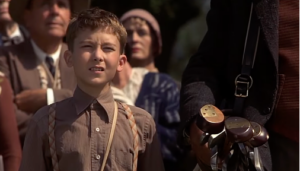 I made this face throughout much of the film as I tried to make sense of it. Firstly, the metaphor itself is beaten to death. I think this story would have been far more effective had it been an ordinary sports movie with the faintest hint of the Gita’s message. Instead of pursuing a more subtle, classier road, the film beats us over the head with “R Junuh” and “Bagger Vance”. We’re unable to come to understanding organically that this is a story inspired by the Gita because the film insists that it is. How, how, how can the complexity of a story like the Gita be captured by a character named R Junuh? This was a weak lowball. If the creators of the film are trying to play coy— which they are, never referring to the Bhagavad Gita by name— they should at least play a little harder to get.
The story begins with a man called Hardy, who is playing golf despite his propensity towards heart attacks. Why is Hardy playing golf despite the heart attacks? I’m honestly not curious and it’s a weak way to start the story. But no choice— we enter Hardy’s life as a small boy in a struggling Southern town to learn why. The scriptwriters preempt any questions about the ending by once again hitting us on the head with the answer, that golf is a parallel for life as a whole.
“It’s a game that can’t be won, only played. So, I play, I play on. I play for the moments yet to come looking for my place in the field” (1:59:50). This feels like a college essay that will end in a rejection. It is all just a bit too trite: Junuh meets Bagger Vance in the dark, eerie night, and when he’s finished being enlightened, Vance leaves him during golden hour on the course, bright green. This is not a metaphor that can bear the weight of these platitudes; it’s simply far too obvious.
This brings me to my second point: the inability of this story to go deeper. The characters exist in boxes and they’re exactly who they seem like. The nuances of each character in the Gita is a critical element of the story… almost no one is one-sided, not even the archetypal villain Duryodhana. There are so many missed opportunities for this: for 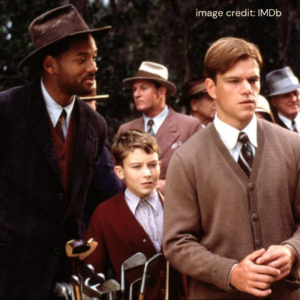 example, Hardy’s shame about his father being a street sweeper. Does he ever really understand that there’s more to life than how you’re perceived? It seems like he just really loves golf and loves Junuh — and his relationship with his father, a good man, is never unpacked to reveal something that could have been a moving and interesting plot line. Adele Invergordon experiences something devastating: the loss of her father to suicide. But this grief is never explored. I found it impossible to like to her when the devastation of the Great Depression panned over to her sitting in a comfortable couch with silk pajamas petting her dog. The search for an “authentic swing” is not as nuanced as the search for one’s authentic self as described in the Gita; maybe this feels extra meaningful to people who love golf, but for the average viewer this simply is not deep enough to appreciate. R Junuh doesn’t go through any great transformation. Bagger Vance’s words don’t have their own spin on them; it seems like the Gita rephrased and not applied particularly well to this context. Take the moment at 1:41:12 – when Junuh is really struggling and looks to Vance for aid, to which the latter replies “I’m right here with you. Been here all the time.” This is arcane, and unhelpful.
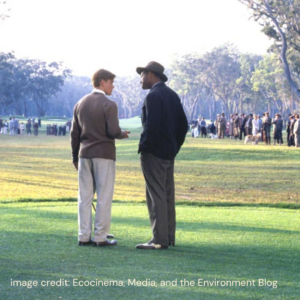 But there is one silver lining to the film, and that lies in the moments in which they succeed in making an impression by being original. The first draws a parallel to a moment that Arjuna experiences eating in the dark. “Now he had understood what it means to aim, but without straining. He had a glimpse of how one may become a channel for the world’s natural forces to play themselves out. How, without striving, without attachment to the end result, abandoning desire and memory, an arrow can be loosed, and find its home. This he learned that night” (Mahabharata). At 51:12 in the film, Vance says “Now close your eyes.” He teaches Hardy to putt with his eyes closed, and it’s a creative and sensitive take on the idea. Equally admirable is the scene crafted by overlaying many nature clips over Vance’s voice narrating how to reach a state of absolute focus. This is the closest we get to seeing his divine side, and it’s pretty cool. “See the place where the tides and the seasons and the turning of the earth all come together,” he says, “Where everything that is becomes one. You gotta seek that place with your soul” (1:16:07). More scenes should have evoked this feeling! We know that Vance is not altogether human; he shows up looking the same age in the final scene. There’s no need to be coy about telling an original story, but that’s what this film does best.
Oh Bagger Vance, I am disappointed. Disappointed that an all-star cast couldn’t salvage the dregs of the Gita from the depths of being lost-in-translation. Interfaith dialogue is absolutely essential in the times we live in, and sharing messages of the Gita with the broader world would have been a magnificent thing. Here, I regret to say, I feel the Gita is just woefully misrepresented. 🤨