The Backrooms



By Navin
21-year-old Kane Parsons makes an incredible directorial debut but falls short of his rival: 16-year-old Kane Parsons.
That sounds harsher than I intend it to. The Backrooms is a genuinely impressive film. The atmosphere is oppressive, the visuals are striking, and Parsons demonstrates a level of confidence behind the camera that many directors may never reach. If someone had said five years ago that a teenager making horror videos on YouTube would eventually direct a major motion picture that would top box offices worldwide, you would probably have been skeptical. After watching this film, anyone would understand. The Backrooms has all the makings of a smash hit in 2026. Moviegoing these days is billed more as an experience than as a film showing and seeing The Backrooms in theaters became a must on 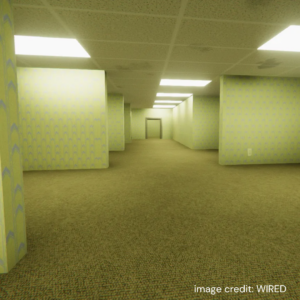 social media.
My criticism is not really about the quality of the movie itself – that speaks for itself. It is about what the movie chooses to be. Kane Parsons (also known as Kane Pixels on YouTube) created the original Backrooms short films, which fascinated me because they were focused on world-building. For one thing, they moved at a glacial pace. Characters were not as important as what happened to them. The camera would linger on empty hallways, strange furniture, and impossible architecture. In short, I think the videos felt more like expeditions than a story. Watching them was like exploring an abandoned building or walking through a museum without a map. You always had the sense that there was something just beyond the edge of the frame. The found footage aspect of his videos also added to the immersion and fear factor.
The idea of “the Backrooms” began with an anonymous user posting this picture to message board 4chan. The photo went viral, and people began writing stories about the place. Kane Parsons expanded this story, showing the Backrooms as an infinite expanse where nothing can be explained; where does the electricity come from, who built it, do the rooms build themselves, what monsters lurk in the purgatory that is the Backrooms? Nobody knows, not even the storyteller. You find out by following 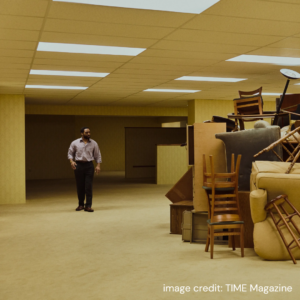 along in the short films. I used to watch the short films while having breakfast, and they captivated me.
The movie shifts its attention elsewhere. Rather than focusing on the Backrooms themselves, Parsons focuses on the lives of the few people who encounter them in the film, particularly Chiwetel Ejiofor’s character and the effects his experiences have on those around him. The film is interested in obsession, loss, and relationships.
There is nothing inherently wrong with this choice. In fact, I think it is probably the choice most filmmakers would make, especially when working with a studio like A24. Audiences connect most naturally with people and the movie now had a necessarily self-contained plot.
Yet I could not help feeling that something was lost in translation. The original shorts treated the Backrooms as the character of interest. The setting was not merely a backdrop for a story about people; it was the story, and the people in the videos struggled to understand or explain them.
In the film, the Backrooms feel reduced to a catalyst, almost. They exist primarily because of what they do to the characters, and Parsons shows that the Backrooms are influenced by the people in the story. As a result, the world feels smaller. Ironically, despite the larger budget and longer runtime, I left the theater feeling like I understood less about the Backrooms than I did after watching a ten-minute YouTube video.
You could argue that comparing the movies with YouTube is unfair. After all, a feature film and a YouTube series are different mediums with completely different demands. YouTube filmmakers have nothing to prove. They can create with the intent just to tell the story lingering around in their imaginations.
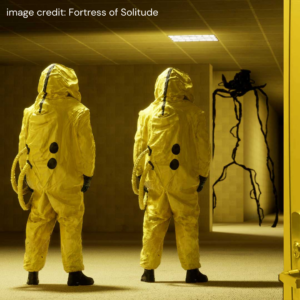 Practically speaking, anyone can tell a story about the Backrooms, and they can tell it how they want to (unless the ideas have been copyrighted and claimed or something, ha-ha). It’s an idea of liminal spaces that we all have experienced in our lives in some way. We’ve all perceived areas of emptiness in architecture and I’d venture to say we’ve all thought about them just a bit. Liminal spaces grab our imaginations.
Where the film succeeds is as a character drama wrapped in analog horror. What it does not quite recapture is the peculiar magic of wandering through an impossible space and wondering what might lie around the next corner. I believe sixteen-year-old Kane Parsons understood that magic a little better! 📸