
Experiences in an eye clinic


My experiences in an eye clinic
By Megan
This summer, I had the opportunity to shadow ophthalmologists at a local eye clinic. A Vietnamese cataract surgeon runs this clinic with two house physicians. One of the house physicians came from the Dominican Republic and the other physician came from Brazil. With physicians from varied backgrounds, the clinic was well-equipped to care for a diverse patient population. Because of this, the clinic has many Vietnamese, Spanish-speaking, and Brazilian and/or Portuguese-speaking patients.
When the surgeon wasn’t in the clinic, I often shadowed the Brazilian ophthalmologist. Observing him with his patients taught me the significance of being fully present. He speaks with patients first, entering notes only after they leave. This physician connects with his patients through eye contact, a calm demeanor, and open body language. 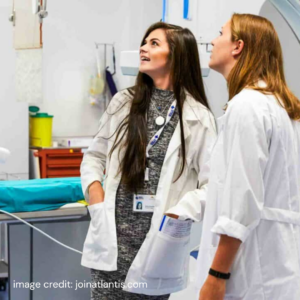
Watching him reminded me that healing doesn’t begin with a diagnosis or a prescription–it begins with trust. And trust is built in those quiet, intentional moments where the patient feels heard. In a system that prioritizes clinical efficiency, this physician takes the extra step to establish trust with his patients. He showed me that presence, empathy, and attention are just as essential to care as any clinical skill.
After one patient left, this physician said something interesting. “Brazilian patients are very particular about their physicians.” I responded with, “That makes sense. I’d imagine they’d like to have a physician who speaks their language.” It wasn’t long before he had to rush to the next patient, but his words stayed with me. His comment wasn’t just about preference, but they pointed to something deeper: how trust can be shaped by one’s culture.
I began to consider how for many patients (especially immigrants or non-native English speakers), trust isn’t earned through medical lingo. Rather, it can be earned through shared languages, cultures, and the comfort of being understood without needing to explain everything. This is why, as physicians, we need to practice cultural competence. We need to commit to meeting patients where they are, in the languages and worlds they call home.
In the United States, the clinical space is dominated by the English language. As a result, other languages can often be 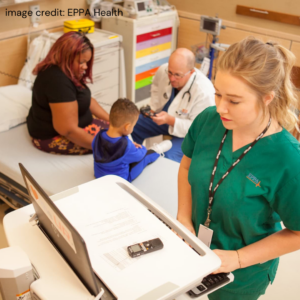 overlooked. This linguistic dominance can unintentionally create distance between patients and providers, making already vulnerable experiences more alienating.
These reflections echoed in my experiences with the Vietnamese surgeon, whose story and approach to care left a lasting impression on me. As much as I enjoyed watching her perform YAG laser capsulotomy, I also appreciated listening to her about her experiences in ophthalmology. She talks about being raised in a small village in the Vietnamese countryside. When she was young, she suffered from nighttime blindness due to malnutrition.
That early exposure with vision loss shaped her path to medicine. Today, she is one of the top ophthalmologists in my hometown. She brings both technical precision and deep cultural empathy by explaining procedures to her patients with absolute transparency and concision. As patients are the most vulnerable in front of physicians, it is the physician’s duty to meet that vulnerability with respect and complete honesty. By breaking down medical jargon into layman terms, she breaks the barrier between practitioner and patient. This clinic’s physicians taught me that ophthalmology isn’t simply about treating eyes; it’s about seeing people clearly.
 Their example pushed me to rethink what it means to care. Medicine can’t be one-size-fits-all. Language shouldn’t be a barrier to trust. To serve patients well, we must not only practice their language; we must also speak to their values, their fears, and lived experiences. To establish care rooted in equity, medical professionals must start listening with empathy and commit to understanding a patient’s reality. 😌