
Early Birds and Night Owls



By Navin
This spring, I enjoyed a lovely Sunday evening with my friends on the club lacrosse team. It was 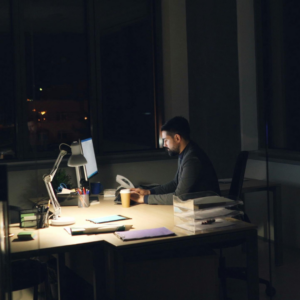 after classes had ended but before the finals period began in earnest, and as a result, we were all relatively at leisure. I left the captains’ house around 12:30 am, and on the way back to my dorm, stopped by the Sciences Library to check on a friend. Though he’d already left for the night, I ran into my sister’s classmate. When much of campus was either in deep sleep or getting there, she had just arrived at the library and was prepping to start a physics study session that she said would (conservatively) last until 5 in the morning. I have other friends that start their day at that time, and other friends who wake up for their 9 am class and then sleep till the late afternoon. What determines whether someone is an early bird or a night owl? Is it a matter of discipline, or biology, or perhaps both? I decided to find out.
In the 1960s, German researcher Jürgen Aschoff developed a study to examine the natural sleep-wake cycle, or Circadian rhythm. He built an underground bunker to house the study, and participants lived for weeks in total isolation. They had simple electric lighting and had the choice to turn on/off the lights on their own. Aschoff found that the participants tended to maintain a roughly 25-hour sleep-wake cycle, even in the absence of sunlight! Though some participants experienced time distortion and even a 50-hour cycle, the study was a landmark in the field, establishing the existence of innate biological mechanisms that are tied to our daily cycle.
 So, if humans possess an internal clock, what determines whether someone wakes up with the sunrise or feels most alert long after the sun has set? Scientists refer to a person’s preferred sleep schedule as their chronotype. Some people are “larks,” who naturally wake early and become sleepy soon after sunset. Others are “owls,” who struggle in the morning but feel energized late into the evening. This is a spectrum, as Till Roenneberg’s Munich Chronotype Questionnaire showed, and most of us fall somewhere in between.
Age plays a surprisingly large role. Young children tend to be early risers, while teenagers experience a dramatic shift toward later bedtimes. As adults move into middle age and beyond, many gradually drift back toward earlier schedules. Environmental factors, such as exposure to sunlight and work or school start times, also play a role. Researchers have also uncovered a genetic component to chronotype. Deep within our cells are “clock genes” that help regulate the body’s daily rhythms. Genes with names like PER, CLOCK, CRY code for proteins that keep time throughout the day by modulating when they are in cytosol and when they return to the nucleus. Small variations in these genes can shift a person’s natural sleep schedule by an hour or more. In 2019, a large genetic study involving hundreds of thousands of participants identified hundreds of genetic variants associated with morning-ness. While no single gene determines whether someone is an early bird or a night owl, our DNA seems to nudge us in one direction or the other. This raises an obvious question: is one chronotype better than the other?
At first glance, my early bird peers seem to have the advantage. Much of modern society runs on an early schedule. Schools, offices, appointments, public services, and many other commitments in our lives are generally designed around morning activity. Early risers often find it easier to align their natural preferences with these expectations. Studies have found associations between night owl chronotypes and creative thinking. Others suggest that night owls perform best when allowed to work during their preferred hours. A night owl forced to wake at dawn every day may appear less productive, not because they are inherently less capable, but because they are operating against their biological clock.
 The consequences of this mismatch extend beyond simple fatigue. Our internal clocks help regulate hormone release, metabolism, immune function, and countless other processes in the body. Researchers have linked chronic circadian misalignment to elevated risks of obesity, diabetes, cardiovascular disease, and depression. Shift workers, who frequently work through the night and sleep during the day, often provide a natural experiment in what happens when biological timing is repeatedly disturbed. Their rates of several health conditions tend to be higher than those of people who maintain more consistent schedules.
While a lifelong night owl is unlikely to transform into someone who happily springs out of bed at 5 a.m. every morning, we can actively try to change our chronotypes. Exposure to bright morning sunlight can shift the body clock earlier. Consistent sleep schedules help reinforce healthy rhythms. Reducing bright light exposure late at night, especially from phones and laptops, can make it easier to fall asleep earlier. Perhaps the most interesting lesson from sleep research is that early birds and night owls are not simply making different lifestyle choices. They are expressing different versions of the same underlying human biology.
The next time you see someone settling into a study session at midnight or jogging before sunrise, remember that both may be following a schedule written deep within their cells, one that has been ticking away since a time when birdsongs were the only alarm. 🐥