Why the First Jurassic Park Movie Was The Best



Why the First Jurassic Park Movie Was The Best
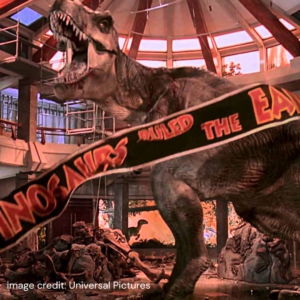 Allow me to stand on my soapbox as I recreate the exceptional storytelling and originality of the first Jurassic Park movie, directed by Steven Spielberg. It’s a testament to the fact that fancy graphics don’t always make a movie great. I’d argue that the original Jurassic Park beats the Jurassic World franchise any day, and that the storytelling in the 1993 movie does justice to Michael Crichton’s sci-fi novel of the same name – which is hard to do because that novel was excellent.
The film starts in the dark of Costa Rica, with a busy crew working hard to quell a small dinosaur who is lifted into the setting by a crane. It’s already mysterious, engrossing. I found myself wondering immediately; why isn’t the most worrisome dinosaur the huge T-rex that we expect? It’s a smaller creature, that is eye-level with the game warden directing the workers stunning the dinosaur. The powerful, timely theme of human vs. nature is already at play. The humans might have guns, we learn, but the dinosaurs still feel dangerous and uncontrollable.
We soon learn that the dinosaur in the opening scene is the ferocious hunter Velociraptor. Alan Grant 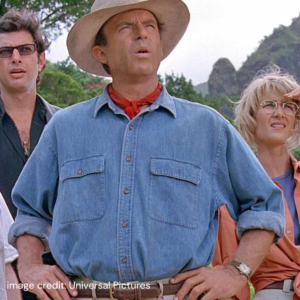 and Laura Dern are introduced as archaeologists and dinosaur experts who are digging up the complete skeleton of a velociraptor.
The segue is effortless, and we learn just enough about the central characters from the exposition. Hammond, the park’s creator, is another well-created figure. He’s a Scottish business magnate who made his fortune ground-up and wins our respect from the opening scenes, ironically, during a moment that he’s absent. He’s away with his daughter, who is going through a divorce. Hammond, however, is the mastermind behind the revival of the dinosaurs. He is playing God, and his all-white attire hints at that tension from our first introduction to him.
The plot flows smoothly. Everyone is there for a reason. We meet Gennaro the investor, representing corporate greed to monetize the park. The chaotician Ian Malcolm is a prescient philosopher who has possibly the best line in the movie, delivered to perfection: “Your scientists were so preoccupied with whether or not they could, they didn’t stop to think if they should.”
Malcolm is a vehicle for Spielberg to reveal his storytelling genius. As a mathematician, he’s quirky, inserts some humor, introduces some interesting facts. But he’s essential for the tension that Jurassic Park introduces, and which feels as fresh and relevant over 30 years after the film first premiered. The dawn of AI has pushed us to ask the same questions, as does biological animal testing, and developing bioweapons. “Can we?” and “Should we?” are not the same.
The CGI that defines films of the 2020s can’t be found in this one. The emotions of fear, awe, horror, come from acting and storytelling more than the VFX. To that end, the cast has been identified perfectly. Ariana Richards and Joseph Mazzello who play the siblings Lex and Tim infuse a grounded-ness to the story. We, or at least I, spent more of the film fearing for their lives. They push us to recall a time before personal devices were ubiquitous; in fact, Tim meets Dr. Grant by saying, “I read your book.” As he chases Grant, famously anti-child, between the two Jeeps, he reminded me of Bill Watterson’s Calvin: a dinosaur-lover who gets his knowledge from books.
Chekov’s gun is a literary concept based on the Russian writer Anton Chekov. The premise is simple: it’s a warning to novelists to avoid extraneous information. The classic example is that a gun introduced in the first act of the play must go off in the third.
The concept comes into play as the group begins their tour of the Park. The driverless Jeeps move past a forested area where an automated voice teaches the visitors about the Dilophosaurus, informing them and the viewers that this is a fearsome predator that blinds its prey by spraying venom at them before attacking. We’re learning so much about the park that we promptly forget this tidbit— until the villainous tech staffer Nedry reappears with the illicit dinosaur DNA he’s trying to smuggle out of the park. He drops his glasses. Dilophosaurus finds him, and I felt a prickle of horror along my spine as I recalled some vague idea that it would blind him. Maybe we don’t remember the initial tour, but Spielberg nudges us with the dropped glasses.
This wasn’t my first time watching Jurassic Park, and it won’t be my last. Crichton and Spielberg have created something evergreen. 🦖