
A Short History of Pool


By Navin
Brown’s campus is full of motion: tour groups arriving, athlete scooters whizzing around, crowds of frisbee-wielding students on the main green. Yet tucked between all that movement are small pockets of stillness. One of my favorite parts of living on a college campus has been discovering quiet new places to study or relax. Many of those corners I am loathe to share in this piece, for fear of increasing traffic. But one of my favorites has been the pool hall in our campus center, seen below.
I’ve never religiously followed baseball, but I still shed a real tear when my family visited the National 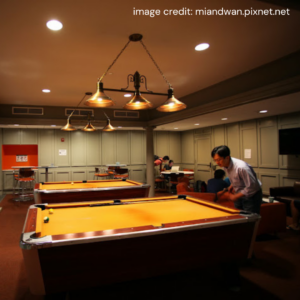 Baseball Hall of Fame in Cooperstown, NY, a few years back. I attributed this to the beauty of the introduction video they played. There was a quote of Lou Gehrig, then a clip of him hitting a ball, with subtitles: *crack of the bat*. Similarly, the first thing that struck me about the pool hall was the sound. No music, not much conversation, but the sharp crack of a break shot would echo around the room. Then came the softer noises: the rolling of balls across felt, the occasional clink of a ball dropping into a pocket, and the quiet muttering of players calculating impossible-looking angles. Some tables were occupied by friends casually passing the time, scratching on every other shot, while others hosted competitors studying and analyzing each shot as if it were a chess move (which, essentially, they are).
Watching the games unfold, I found myself wondering how this became one of the world’s most recognizable games.
The answer begins surprisingly far from the felt-covered tables we know today. Historians generally believe that pool evolved from outdoor lawn games played in Europe during the Middle Ages. Early 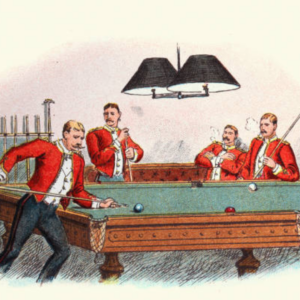 versions resembled croquet more than modern billiards, with players striking balls through arches and around obstacles. Eventually, these games were brought indoors, where wooden tables replaced grass fields. To keep balls from rolling off the edges, raised rails were added around the perimeter. Over time, players began intentionally using those rails to bank shots, transforming the strategy altogether.
As the game developed, it spread throughout Europe, particularly among bourgeois and aristocracy. French nobles were fond of billiards, and many of the terms still used today have French origins. The word “billiard” itself likely comes from either the French word bille, meaning ball, or billart, meaning wooden stick. In those early years, the game was associated with royalty and wealth. Kings, queens, and noblemen commissioned elaborate tables and spent hours refining their skills. One famous player was Mary, the Queen of Scots, who was reportedly distressed about losing her table during her imprisonment!
Eventually, billiards crossed social boundaries. By the nineteenth century, technological improvements made tables more reliable and affordable. The introduction of rubber cushions dramatically improved the consistency of bank shots, and slate table beds provided smoother playing surfaces. As the game became accessible to more people, dedicated billiard halls appeared across Europe and North America.
The version of the game most Americans recognize today (pool) emerged during this period. The name “pool rooms” may have originated from gamblers contributing money into a collective betting pool. Over time, the rooms became so closely associated with the game that the name stuck.
Pool’s reputation has shifted repeatedly over the years. At times it was viewed as a gentleman’s pastime. At others, it became linked with gambling, hustlers, and smoky backroom establishments. Hollywood embraced this image, and many movie gangsters have done their dealings with compadres playing pool in the background. Yet spending time playing pool today reveals the same satisfaction found in countless other hobbies: the pleasure of incremental improvement. Every shot presents a puzzle and there are as many breaks possible as scrambles on a Rubik’s cube. The game rewards 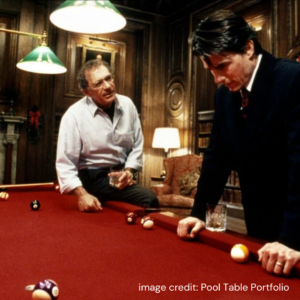 patience, precision, poise, and creativity in equal measure.
Nearly everyone at Brown seems to be rushing somewhere with something to do. There is something refreshing about slowing down to focus on a single shot. For a few moments, nothing else matters, just angles, momentum, and six pockets waiting patiently at the corners of the table.
Not a bad way to spend an evening! 🎱