
Themes and Hidden Messages in Miyazaki’s



Themes and Hidden Messages in Miyazaki’s
Spirited Away
If you’ve heard of Studio Ghibli, you’ve probably heard of famed director Hayao Miyazaki. His reputation precedes him tremendously. Hardly a year goes by that someone doesn’t recommend his famous film “Spirited Away” to watch.
But what makes this famous movie worth the watch? And what are the underlying themes and messages which might be takeaways?
The whole movie has a bizarrely dreamlike quality to it. Nothing is predictable, and all the characters, from the human to the straight-up demonic, have unexpected sides to them, beginning with our main character, Chihiro. Miyazaki is said to have created Spirited Away to tell a story with a ten-year-old girl as the main character. 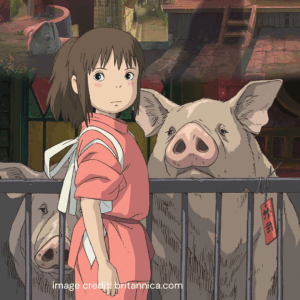 He felt that young girls should have the opportunity to take the lead in a wild adventure. And Chihiro does exactly that, going against the grain of usual popular media, which suggests that ten-year-old girls are mostly preoccupied with flirtation, pink sparkles, and Hello Kitty- as a report by Utah State University put it. Chihiro begins whining about her family’s impending move to another town. “The first bouquet I ever get, and it’s because I’m moving. That’s depressing,” she says. But unlike her parents, who reveal themselves to be terribly consumer, and fellow workers in the bathhouse, Chihiro isn’t obsessed with the material. Throughout the movie, characters that are greedy or gluttonous receive their “just desserts.” Chihiro’s parents turn into pigs. The bathhouse workers who clamor for the mystery guest’s gold bits get swallowed by him.
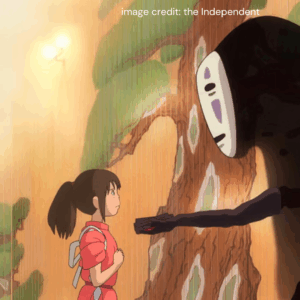 Friendship isn’t represented in the typical manner in this movie. Chihiro relies on friends not only to survive but to save her parents and to fulfill her destiny. Her friends make her better and braver- without them, she might not have made it. The mysterious world she stumbles into is a bathhouse for Spirits, who come and rest in the facility owned by a cruel witch named Yubaba.
Thus, none of Chihiro’s friends look like a ten-year-old girl’s typical set of friends. One of the most loyal is the spiderly-looking old Kamaji, who fuels the boiler room for the bathhouse. Kamaji is a bit creepy and off-putting at first glance, but he suggests that Chihiro strikes a deal with the witch Yubaba, which is what lands her a job at the bathhouse.
Moreover, when Chihiro is trying to save her friend Haku, Kamaji gives her the train tickets he’s been saving for years. He wants to get away from that madhouse of a job just as much as the rest of them, but, because of Chihiro’s love for Haku, decides to give her the tickets for free. He expects nothing in return. It’s a reminder that strength and help can and will come from the most unlikely of places, and that kindness and genuine compassion will be repaid in kind. Chihiro winsfriends by her attitude of treating people well and determination to save her family.
By expecting nothing, she seems to gain everything. Her “big sister” in the bathhouse is another human worker called Lin. Lin is initially cold to her, but is soon very kind and very welcoming. She advocates for Chihiro and looks out for her during the day to day activities in the bathhouse when no one else does. Chihiro doesn’t even realize or acknowledge this, really, but without Lin life would have been much more unpleasant at the bathhouse. We can all be Lin to someone. We can take newer coworkers or students under our wing. For a newbie, even seeing a familiar friendly face can mean the world, as I realized during my first year of college.
Chihiro’s forthrightness is endearing to those around her, in the movie. She faces all 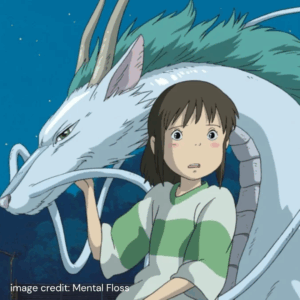 kinds of creepy monsters but, after her intial confusion, takes everything in stride. She judges not, lest she be judged; upon meeting Yubaba’s twin sister Zeniba, Chihiro treats her with respect and humility, addressing her at “Granny,” even though the latter is an exact replica of the wicked Yubaba. Zeniba indeed turns out to be a good person. Maybe it’s this kindness that appeals to the mysterious and temperamental Haku. Haku is mad at someone/everyone for at least 80% of the movie, which is justifiable when you think that he was once a river spirit who was left homeless when the riverbed was drained to build an apartment complex . This theme of the natural versus the unnatural bleeds through the entire movie. Spells equal deception in the movie, like the curse Yubaba puts on Haku to control him. The food that appears to the parents is unnatural, and they eat it to their cost. Great movie.